Youtube doesn’t appear to have a flip option, at least in my limited understanding.
And the original file is on another computer that I’m not near for now, I’ll see if there is a way around it eventually…
I’m guessing it’s a mistake I will/may not repeat now that I have done it so publicly.

Thanks, I got a FF version .
I’m sure you can flip it in DaVinci Resolve or another editor.
Fantastic video Box ! It’s always great to see artisans/craftsmen doing their thing. 

Stunning work. Bravo ! 
@Box, how do you come up with the colour palette? Is that something the client specifies? Or do you have to match / coordinate with other existing windows? Or do you get to apply your own creativity…?
My late father also designed some stained glass work. The colour palette is somewhat limited - I still have somewhere a box with all the then available coloured glass samples. I don’t have them at hand now but there used to be less than a hundred different shades.
Simple answer, Yes, all of the above.
Each job is different and entirely dependent on both the client and the location.
Restoration work is about matching existing, trying to mix and match if necessary to blend everything into a unified whole.That sometime requires us to move glass around in the original to make the new glass make sense, as if it has always been there.
Conservation is a different ball game, you must not change anything, it can be very difficult working with a Conservator. I’ll leave that there.
New ecclesiastic work depends on many things, what the committee wants, what the donor/s want, what the clergy want, what previous work there is in the building, what the budget is and so on. This all needs to be considered when designing a window. Not to mention the light and how it fall on the window throughout the day or how the space will be used. For example one recent job required that the windows be safe from being struck by balls from inside as they used the space for all sorts of ball games. With that in mind there are also ‘standards’ that you have to apply, no single piece of glass can be more than a specific size unless it is laminated or toughened and certain glasses cannot cope with either of those. If any part of the window is accessible to a person who decides to headbutt it, lean against it, jump up and kick it… all these things effect what you have to work with.
Public spaces…hmm…lets not delve into the issues with designing anything for a fully public space, suffice to say it is several levels of magnitude more complex than a place of worship which is sort of private but has public access. Given full public access everything has to be wrapped in cotton wool and needs a sign saying cotton wool may pose a choking hazard.
So all those things considered you can start to think about what glass and options you can get away with and design to suit.
Private domestic, you get to know the client, you look at the light, you get a feel for their likes and dislike and take in as much as you can about them. You find out if they have a design in mind, many do (which can be a challenge) or if they are open to a contemporary design etc etc. This can be a very complex dance, Oh, we love everything you do…Ah, but not that, eew no no no, more like that one we showed you in the magazine,…Oh god no but that was awful…I thought you were joking when you showed me that…
So you still have to consider budget, complexity of design, choice of glass, painted, engraved, etched, plain, textured, mouth blown, machine made and so on and so forth.
Then you need to back off a bit and look at the actual house, you sort of need to remove the interior decoration and look at the bare bones, this way you can design in such a way that the next owner can decorate differently but still work with your design.
Every job is different.
Some people have design books where you get to choose what you want, like going to get a Tattoo, and they are scaled and priced accordingly. No point me commenting on what I think of that. Nor will I mention how many times I have had to repair/replace work like that. In truth, even what are called ‘leadlights’ patterns of glass and lead that have been used in houses for years, many particularly beautiful ones, art deco, art nouveau, federation (an Australian specialty) really need good designers to get them right.
I’m sure that was the case for your late father, but that would have been a selection from perhaps one glass supplier. There have been and are many many different suppliers that come and go over the years creating an almost infinite range of colours textures and shades.
I can still picture the colour chart we had hanging in the studio when I was first an apprentice, it was a grid of 2 inch squares 20 rows across and 30 rows down all arranged chromatically. Each had a number and or letter that was used to colourscheme the designs. This allowed the guy cutting the glass to select from the racks and cut what the designer wanted.
A single sheet of mouth blown glass can give you multiple shades and variations within just one colour and sheets can be done with multiple colours. The range is nearly endless and the nuances possible bring delight to the eye. Not to mention the ability to change the colour with stains, enamels and paints.

I recently picked up a new sandblaster. This one is a pressure pot extractor system which basically means you put the air into a vacuum cleaner that has sand in it and it is a closed loop. This allow you to use it outside a booth, blasting cars, large panels etc
The downside of the system is it has a brush fitting around the head to contain the blasting media, which means you can’t see what is going on. When sandblasting glass you generally need to see what is going on because it’s a bit more like airbrushing than savage cleaning.
To that end I designed a new head for the thing that lets me look in while still capturing the media. A ‘quick’ 3d print, and a bit of replaceable glass and tape and away we go.

The skp

The slicer

The print

Ready to go.
Nicely done; how well does it perform?
Looks great, excellent solution. I second the question; how well does it work? And who’s the manufacture?
The unit itself works extremely well as a sandblaster.
I have just tested my contraption and it works better than expected, visibility is excellent and the grit recycles fully without escaping. The only problem is it works too well in the vacuum department. The seal is so good that you can barely move the thing around. I had already added some holes to reduce the suction, but I’m thinking I need to print an inline slide like vacuum cleaners have so I can control the suction.
I believe it’s a Chinese product, Vevor. Quite cheap in the grand scheme of things and arrived almost before I ordered it.
I can also see that it could be used with a booth if you wanted too. I’ll probably build one for it before long. I like how versatile it is.
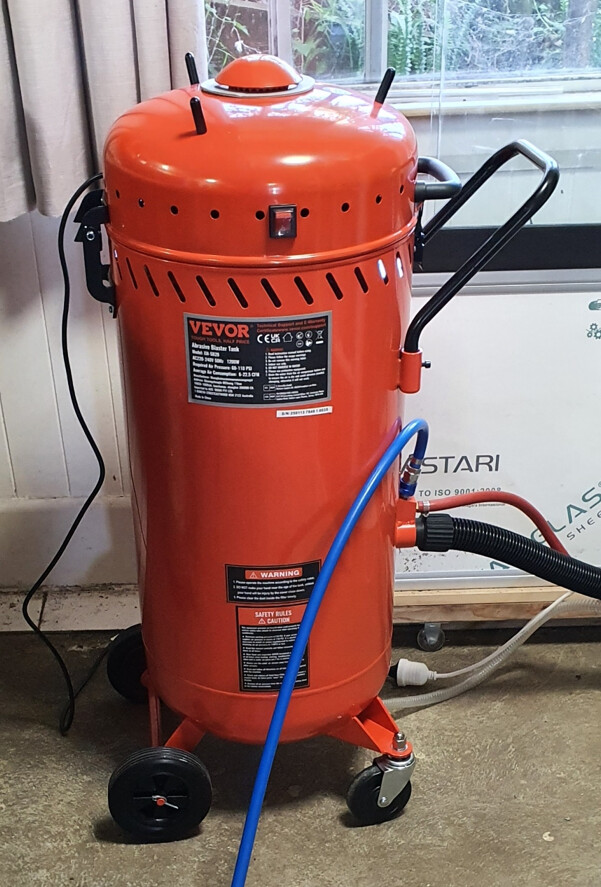
I’m glad your Blast guard/ viewing apparatuses works better than expected! A good design. And thank you for the manufacture’s info.


Good fix!
A little graphic job for a friend.
I’ve used 3d to create a 2d image for laser cutting.
Here you see the model, a set of cards that I used radial bend to shape.
This gives me a workable image that I can work into a set of laser paths.
The model.

The export.

The tool paths.

The colours are telling the machine what to do, once I do one I’ll see if I need to make changes. The green is set as a crosshatch pattern just to give it a hint of a playing card. Usually only the flush would be seen. It’s a token to place on your cards while paying poker. 60mm dia.
I should manage to fire up the laser to show the result in the next couple of days, assuming I don’t melt in the current 40deg C heat. You should hear the fans in my PC at idle.
Very minor thing: will that be bent as well?