Since I’ve been focusing on updating the stair module the last week I’ve had quite a number of requests for various things. One request is the ability to flare out the bottom of the stairs. I can add in this functionality however to start with it would be very rudimentary (just a modification to the treads and risers as shown):
I’m not entirely sure how one would go about in-fill framing the flared portion, nor do I think there is any established or standard way to do this, I could be wrong. Any thoughts or ideas in this regard? I should probably ask first if this is something that you would all want or even need.
From what I’ve seen in previous projects, the inverse rounded/flared step is in conjunction with curved wall on each side and the treads are secured to nailers or cleats on the wall framing (i.e. custom framing condition). I would say that in over ~30 years of practice I’ve only designed stairs like that maybe twice. As such, I’m inclined to say that it is not very common condition however if you were inclined to program more common stair options I would suggest full round, half round or extended treads (see examples below) with options for asymmetrical left/right conditions.
Here is a quick study of the three types of tread extensions that are probably the most common. I can probably make this happen but it will have a number of new parameters in yet another sub-menu.
With the half and full round, the riser simply follows the nosing dimension, however with the square cut extension the amount of the riser extension could be independent.
For both the full and half round the radius of the curve is paramount but also the placement of the center of the curve in the Y direction (perpendicular to the stringers). The extension variable can be used for the Y-dir placement of the curve.
The round nosing makes things a bit interesting but that can also be dealt with by breaking things down into a piecemeal modeling algorithm and then using some boolean addition of solids.
Extension Side: Both, Left, Right
Extension Type: Square, Round, Half Round
Tread Ext. Length: 10" etc… (this variable also sets Y placement of center of curve)
Riser Ext. Length: 8" etc… (only applies to the square ext.)
Extension Radius: 10" etc… (only applies to full or half round extension)
I never get a day of rest, maybe after this update I’ll move back to the Floor plugin…
I’ve been going pretty solid at the code for the last couple of weeks, it is good to actually get some work done and make a bit of progress for once. Tonight I decided to take a small break and take care of some other low hanging fruit I’ve been meaning to do but have not had the time to do it.
In 2018 I modeled a few handrail fittings that I found on L.J. Smith (www.ljsmith.com). Tonight I spent some time and completed a full library of those fittings for the every popular 6010 handrail profile. I’m not sure how much I can incorporate these into the handrail module but at the very least they will be available as a library of components that the user can bring into their model if they want to deep dive into handrail layout and design:
As usual they are dimensionally accurate per the manufacturers documentation (which is actually quite good, surprisingly). Each fitting is a clean solid. The polycount is a little high for my liking but I did my best to keep it under control while maintaining a high level of realism and detail.
Technically you are probably correct, it really has no dependencies on the wall plugin or walls in general, it is kind of a stand alone module with the plugin, a plugin within a plugin. If anything it probably belongs in the Floor plugin. I will give this some more thought.
Ya I find that everytime I’ve use the stairs plugin so far i’ve had to create tags for it since there is none created and now with all these options coming up we might want to assign tags to the different parts of the stairs
Up until now I’ve just lumped all the geometry into the framing tag/layer, your right it needs its own layers/tags and maybe its own plugin. I will see what I can do.
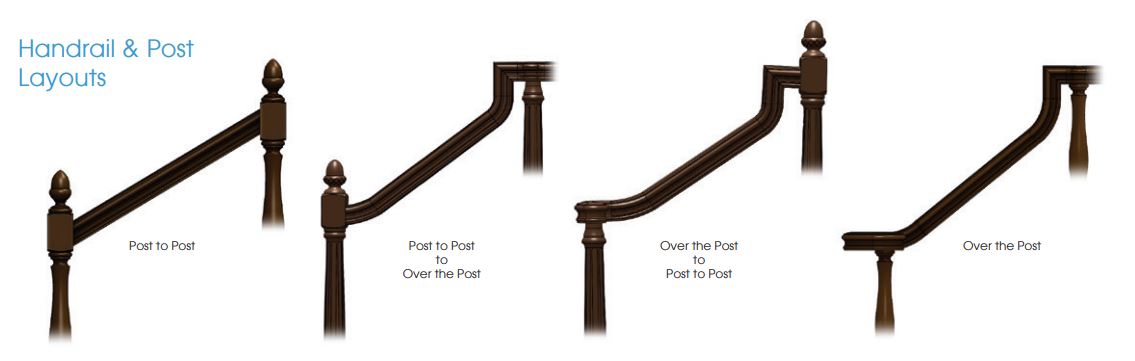
If I enable some turn outs and volutes I will need to adjust for these but also I need to provide some additional parameters so one can fine tune the placement of the handrail and its termination:
wow again great work on this man, there is so many options now for stairs railing, from classic to modern look and I find more people like to go with glass stuff now too which can get expensive but some of the house I design now people like the feel of the “Open Look” and glass is now a big part of that
There are other profiles for which I can create the standard turnouts and volutes but I will leave it to the user to provide additional fittings for other profiles if they want to do that for now. At some point I may add a few other popular profiles if requested.
L.J. Smith has a lot of literature on their site which is helping me understand the way handrail systems work, there are a lot of options even for a more traditional handrail system:
There is probably a limit to what I can offer but I will update the handrail module so that one can specify the termination options for over-the-post handrails with a bit more specificity
I think you may have realized that stairs and handrails are the proverbial rabbit hole… Nonetheless, thanks so much for all your efforts in not only updating the extensions but also creating additional value to them.
They certainly can be if you really deep dive into all the customizations (ie. curved staircases, spirals etc…) I just want to cover the majority of the basic cases and I think I can still realistically add a lot to the module to achieve that without going too far down the rabbit hole.
You are right, I could easily spend an entire year really building this module/plugin out but I currently have too many other fires burning right now to get too far into the weeds on this one. so I will pare back my ambition and try to keep things reasonable. For now I’m working on the first tread extension (starter step) and the additional handrail options. I may also expand this slightly to offer full tread extensions (open tread) for both sides of the staircase along its entirety but I’m still not sure on how I want to handle that yet.
Here is an excellent diagram showing the anatomy of a complex staircase:
When I talk about open tread here is what I mean, notice how the tread typically overhangs the staircase and the skirtboard is then applied below the treads, whereas with a boxed in stair case the skirt board is above the treads:
So I basically I want to add in an option for open treads (both, left or right) and also the starter step or bottom tread extension for turnout and volute type handrails, yes this is a can of worms for sure, but it is all very doable.
The issue here is that each run of stairs literally needs it own handrail sub-menu (set of parameters). Globally the handrail options are fine but as soon as you start adding landings you then have multiple stair runs and it quickly gets complicated. Note that the same handrail settings get applied to each run of stairs currently, this is less than desirable with complex stairs.
Of course the workaround for this is to not rely on the automatic landing functionality and create each separate run of stairs as a separate assembly (linear stair runs only). However this negates the convenience of having the landing and winder options that I recently added.
Yes, I’m a bit in the weeds now but I want this new handrail system to be as functional and fully featured and efficient as possible. I will need to put on my thinking cap and come up with a viable solution that is not too complicated (for a complex problem).


 you keep going with this the stairs should almost be its own plugin