Creating a 3D 1:48 scale Model of Edward Hopper's "Early Sunday Morning" Painting

Just when you think it’s safe to go back in the water…

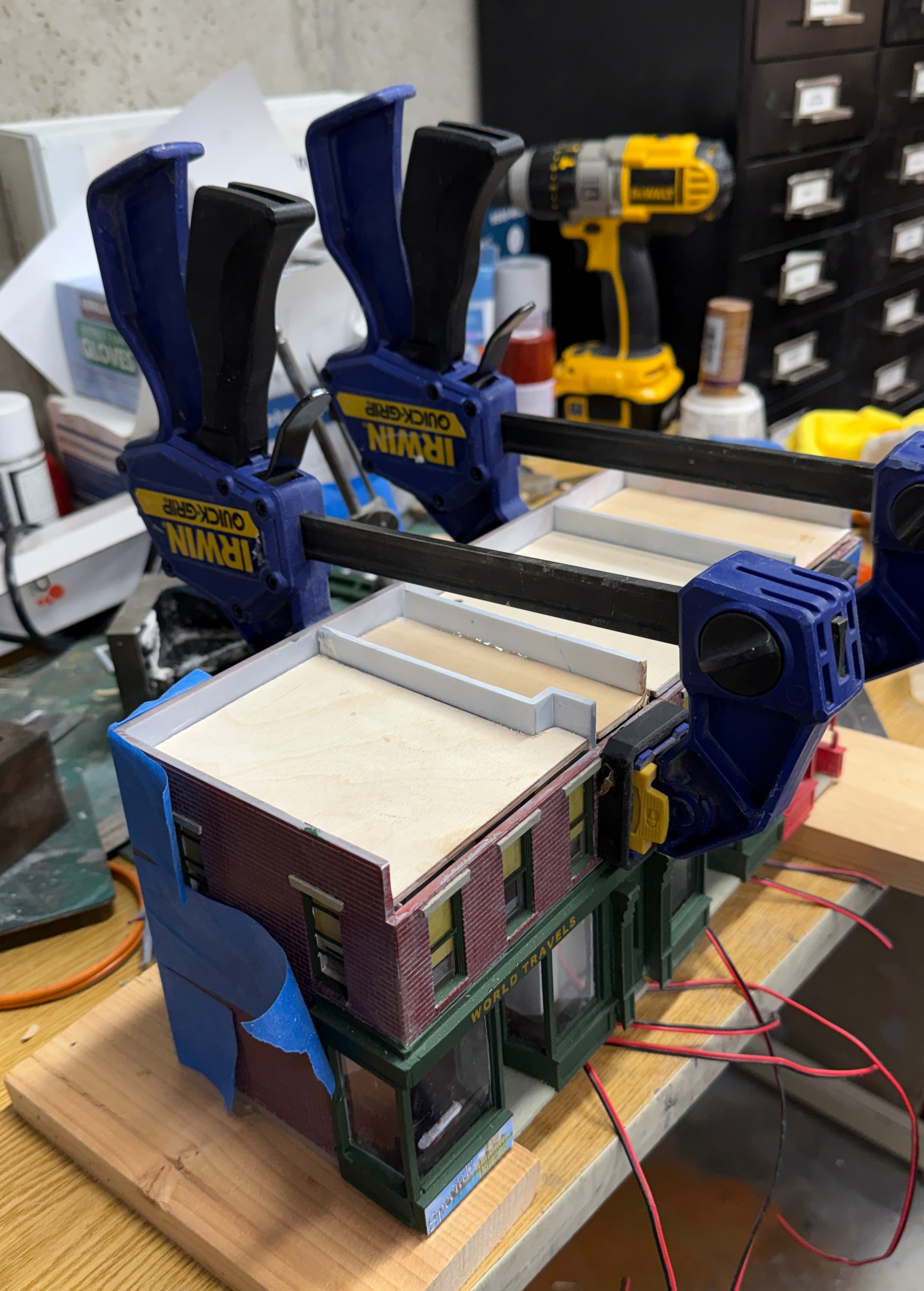
I epoxied the floor to the struture with no difficulty. My clamping scheme was okay. While it was curing I built the power board.

I’ve gotten this build-a-power-board process done to a science.

I’m using these cute little modular terminal blocks. They have a tiny v-shaped rail that slides into a similarly shaped slot to add as many as you need. They solder into the circuit board. For the positive terminal I have each block isolated and solder jumpers to each contact. For the negative blocks I solder them to a bus made from adhesive copper foil.

After inserting and soldering the blocks, I added the CL2N3 LED driver chips. These inexpensive marvels take in 5-90 VDC and output 20ma which is loved by LEDs. They can service as many in series as your power supply can allow. Each LED drops 3.3 volts, so with a 12 VDC power supply you can power 3 LEDs in series. CL2s do not like parallel circuits. If you parallel LEDs one leg receives no power. I figured I would need five separate circuits for the building and another for the street light and the illuminating the barber pole.

The CL2s have three leads. One is input, one output and the middle is just for support in soldering to the board. There is a flat side. When looking at the flat side, the lead on the left is input.

Here’s a few shots of the board bottom. The input leads all are soldering to the 12 VDC bus. The middle leads are crimped over and soldered for strength. The output leads are left facing straight out so the output leads can be soldered to them individually.


The topside shows the CL2s all facing in the correct direction.The output. bus terminals are in the foreground. The terminals to the right are the ground terminals.

I tested all the circuits and they were live. I installed a toggle switch just for fun.

After curing the front corner of the floor was sitting proud of the wall. I tried to sand it down with my multi-tool, but while being horrendously noisy, didn’t have a sanding head that was coarse enough to make a difference.

Then I got the “brilliant” idea to “carefully” hold the bottom onto the belt sander and just take off the high spot. Note the words in quotes. This worked in removing the stock. However, it also work in destroying the wiring that was coming out of the barrel store. Not only did it instantly chew off the insulation, but it proceded to destroy the conductors on two of the wires; one positive and one negative. This image was taken after I removed the other part of the leads. Since I only had two LEDs on the first floor and one on the second, I was planning on making them in series so I salvaged the two leads of the two separate sets and soldered them together.

I added some shrink tubing to insulate. After attempting to power it up, it failed. I then found that the existing ground wire, which I thought just lose some insulation, was in fact, a failed wire. I spliced more black lead to it. And tested again.

Then I found this!

The strain on the wiring actually tore the lead off the solder pad on the copper foil. This is effectively “in a closet” and was unreachable. I couldn’t fix the second floor so I wrote it off. One apartment will not be lit and that’s not too far fetched. But I had to light the store. The only option left was to bypass all the previous wiring and run some new lines. Bypass surgery so to speak.

I had to scrape the paint off the copper foil to make it solderable, and the reach into the room to tin the new spots. Then I had to solder leads in there also. Lighting was poor and working room non-existent. However persistence paid off. It ain’t pretty, but I got power to the lighting.

I routed the wiring to the wall, drilled a new hole in the floor to pass the wires below and used some Bondic to help hold them in place.

While you can see the wires from this angle, I’m expecting that with the store fronts in place, much of that will be blocked, or at least, not so obvious. Notice the broken post on the store front. That’s been broked and repaired more than once. I pops togeether nicely and will be okay when the building is complete.

And one person wins the “eagle eye rivet counter award” in noting that on my side, the store is called “Ye Olde Oaken Barrel”, but when I did the signage in the window called it “Ye Olde Barrel Shoppe”. Take your pick…

While I was hoping to get the building buttoned up in this session, but, as usual, I spent as much time going backwards and going forwards. I can’t complain. It’s my hobby and nobody’s forcing me to do it.

I am never, ever going to attempt to 3D print an entire building of my own design. I can imagine doing the exterior walls, but that’s it. All the rest will be crafted old-school.

Before doing anything on the building I had to make relief cuts in the pavement base for the wiring. I used the Dremel with the router fixture and a carbide mill to open up the spaces. Nothing bad happened!

Then I actually got the building together today. It was a harrowing experience akin to watching “The Shining” all by yourself in the dark. Each time I attempted to get the front assembly to align properly to the rear, something was pressing on something else preventing a proper mating. It started with the 2nd floor plate not being square with the building and jutting out enough to prevent the right side to nestle correctly to the floor plate and the rear corner. Cause? The 2nd floor was not properly fitted to the partition and was pushing it out of line. Blame the contractor.

Using the Dremel with an abrasive cutoff wheel, I surgically removed the extra and then had to remove all the sawdust. That solved one problem.

Then I tried fitting again, and the front wouldn’t move back far enough. Another thing was blocking. All the tabs that I had so dutifully drawn and printed were causing interference problems. I ground them off. In the process I destroyed the barrel store window. That was no big loss since it was the wrong store name anyway. I cut out a new piece of glazing.

Then one of the two stairwell walls was sticking out 3/32" bulging the wall enough to prevent the left corner miter from closing. Again I had to saw off another wall. This one was all resin versus the other being plywood. Again, more sawdust mess that had to be gotten rid of in the finished interiors.

Finally, the lower right corner was not aligning with the floor, which was sitting lower. I epoxied it with a monster clamp because my model-sized Quickie Clamps are about 1/2" too short to clamp the full building height… which is a pain in the you-know-where. In the process of doing this, my finger went through the travel agency window popping the lower half loose. i don’t know what I’m going to do about this, since I can no longer do anything inside. Which is why I should have found a way to screw the floor in place and not epoxy it. The lessons learned with this project is a very long list which I will delineate when it’s finished.

The building shell is now complete! I immediately added the upper cornice. This actually went on pretty well considering.

I couldn’t resist putting the building on the layout to see how it looks. It’s good, but of course, it sitting crooked because the building is not connected to the pavement base nor inserted into its socket. But you can get the idea.


Tomorrow I will get the roof started and finish up the wiring. I prepared the circuit board to attach to the underside of the floor. I’m looking forward to tomorrow’s tasks as they should be less exhausting and emotional.

Oh dear! Measure once, cut two or more times!

From what I’ve been told, the mark of the “Trur Professional” is not that you make mistakes, but how well you recover. I recover very well. I most likely have ADHD. My childhood school experience is classic, although it was not diagnosed in the 1950s. As a result, I tend to work too fast and pay the consequences. That said, this project was an experiment and to expect no diffiiculties would have been unrealisitc. Or at least that’s what I’ll keep telling myself.

Short session, but I didn’t have to fix anything, so that qualifies as a good day. I attempted to match the concrete color of the adjacent sidewalk to the new base. Got close, but it’s too dark. I may, or may not mess with it more. It will be hard to see because the match line is on the view that’s not facing anyone. It looks like I need a taste more yellow and some more white to lighten it a bit. I may us Buff color instead of the white and yellow.

I can never mix two batches of concrete color to match. My entire layout is a series of differently shaded sidewalks. Notice the color of the sidewalk across the street… It’s more greenish.

I’m using black construction paper to simulate the tar roof. I got the flat pieces installed and am working on the parapet pieces. I’m overlapping the sides on the bottom and will paint simulated tar strips when they’re all in. I can install fine gravel on this base to make it more ‘realistic’. That’s not really black, but looks more like NATO Black.

Just for fun I popped a piece of parapet capping to see how it looks. They finish it off nicely. I’m using tar paper over the partition walls that penetrated the roof. I will touch up the dark green on the cornice which is taking a beating while working on the roofing.

Things will be moving quickly next week and I’m predicting a finished model by this time next week.

Happy Friday! Y’all have a nice weekend.

Getting near the finish line, but it isn’t getting easier. I finished applying the black construction “Tar” paper to the rest of the roof, and prepared and mounted the chimney with some flashing. I also added a couple of stack vents for the sanitary sewer lines. I then attempted… poorly… to apply some gravel to the roof after painting the tar paper with a gray-black mixture of artists acrylics. The paint absorbed into the construction paper to easier and wasn’t wet enough to keep the gravel in place. As I attempted to add more paint to the trouble areas, things went from bad to worst. I ended up removing all the grit and just painting it with “tar”. I added the small filler piece in the front right corner. Finished the electrical service by adding some conduit clamps, although not without undue trouble. I think that’s my middle name. And lastly I filled the other two building corners. And I popped the right side window completely out! I no longer can afix it from the inside, so I’m going to do a minor mod on the frame to enable me to add the glazing from the outside. Never a dull moment.

The plain tarpaper roof looked so nice I should have left it alone. Shoulda, woulda, coulda…

While I was handling the model the weather head detached from the wall. I figured it was time to get the clamps on. I drilled the weather head for a piece of 0.025" wire to pin it in place. While fussing with it, the weather head separated from the conduit. I didn’t think gluing it together would work, so I removed it entirely and got a spare print and installed it. Of course, its weather head separated also when I was working on it, so I lived with it I did successfully pin it.

I used 0.015" wire to do the clamps. Between the clamps and pinning the head, it was stable enough to let me glue the head to the conduit with CA.

I added the filler piece to cover the gap what was on the left front cornice corner. I made a laminate of a piece of 1/8" ply plus two thickness of 1/64" ply to make a piece that fit snuggly.

The chimney got the Copper-foil-flashing routine, but it was overkill since I overpainted it with the simulated tar.

I made the plumbing stack vents from 3/16" brass darkened with JAX bronze darkening fluid. I drilled two #30 holes to accept the pipes.

I then painted the right roof portion with the black gray acrylic mixture, and sprinkled the fine ballast gravel on it. I was disappointed that there were many spots where the gravel didn’t adhere. I attempted to freshen the paint in those areas, but that was making a mess. I ended up stripping off all the gravel and painting all the roofs as if they had a layer of brushed on hot tar.

The constuction paper wrinkled when wet, but the bulges settled down as the paint cured.

I filled the two opposing corners with Tamiya filler. After filling I sanded lightly, used a fine razor saw to re-scribe the mortar lines and then dry-brushed the dark red. I slathered on the gray mortar and wiped off excess. I finished up using an Isopropyl/India Ink wash and got decent results.

Before:

After: Notice the filler piece is now painted in this view.

I also did the long rear joint. Results were similar although I didn’t shoot an “After” shot.

While turning the model upside down to keep dumping the errant roof gravel, I put my finger through the left end window. I’m going to modify the framing a bit to accept and hold the glazing from the outside. It’s too bad that I chose to glue the floor in. I could have made it so I used screws to hold and would have been able to open it up. Lesson for next time.

Here’s the finished roof under different lighting.

Last thing I did was final fitting of the paapet capping. I will epoxy this in place tomorrow. And fix that window.

We’re just days away from putting the thin model on the railroad.

Milestone Day!

The roof parapet capping is now on after some minor cleaning out of the insides from some leftover printing nubs. I then fixed that missing window. I added a piece of 0.060" square stock to the window as a new mounting surface.

I measured and cut a piece of 0.015" clear styrene. I chose a thicker stock so it wouldn’t distort to badly. I used a different adhesive this time. Formula 560 Canopy Glue from Pacer Tech. It’s used by the RC guys all the time. It’s really a PVA kind of cement with a fairly long cure time, but it dries clear and adheres to styrene. This image is when the window was just installed. Installing from the outside is not prototypical, but it sure beats no window at all.

Here’s the glue:


With the topside stuff done, the next big thing was mating the building to its base. I needed to determine the location of the large hole that I drill through the sub base, so I could correctly orient the circuit board under the building. I used Aleen’s Tacky Glue and lots of gravity clamps to hold under it cured.


When the glue cured enough to decamp, I turned the assembly on its side to expose the bottom. I used servo tape to secure the board and started to sort out what wires were going directly to the board, namely those with 3 LEDs on the foil, and those that were going to be wire in series under the buildng. I then trimmed and added ferrules to them.

After getting all wiring completed and terminated, I was rewarded with this…

The color difference of the LEDs is deliberate. I wanted the cool white to simulate old-school florescent lights and the warm white ones for old fashioned incandescent bulbs. Looks good to me.

All that’s left is doorknobs, TV antenna and the hanging signs. Those signs will be the last thing that goes on before the building goes to the layout. They’re very delicate and the less time they’re on the bench the better.

Speaking of doorknobs… I took some brass brads, chucked them into the Dremel and, using a fine diamond-coated file, changed their shape just enough to be convincing knobs. They’ll go on tomorrow after drilling a #55 drill hole in the doors. I may have some trouble with the barber shop door being it is an angle.

See y’all tomrrow.

I got the other window replaced and there’s at least one more that’s going to get this treatment.

I was hoping to finish the job today, but the barber pole was not cooperating. The drawing had and error and the upper half of the transparent part was not physically connected to the lower part. I tried to make it work and it took most of the afternoon. I eventually got something together, but it’s not up to my standards. I redrew the parts and it’s in the printer waiting for work to begin again on Monday.

When I first cobbled it back together, I realized that I’d forgotten there’s a straight portion. When I sat on the model it looked terribly short.

I broke off the upper part and added the spare midsection. Of course when I glued it all together again (with Bondic) it was crooked and didn’t look really good. I painted the lower, non-translucent portion just to see if it would work.

Meanwhile, I drilled the holes for the light pole and barber pole. Opened up wireways in the base with a router, and got the light pole in with its wiring, and wired an LED that’s going to be Bondiced to the open bottom of the barber pole. I tested how the lighting would work in the barber pole and it’s okay.

Again, I used Bondic as a “liquid” wire clamp. Believe it or not, the poles use Black for + and white for —. Who ever came up with that scheme?

The barber pole opening.

With only two LEDs to light, I wired the two poles in series and tied them to the open terminal #6 on the barrier strip. I’m glad I had the foresight to add that sixth circuit knowing that the poles would be lit. That’s no my typical way of working..

Both lights are working successfully.

Once the barber pole problem is fixed, the model will be complete (other than adding that one more bad window.)

On another front, I finally got some working drawings for the Steering Gear of the Battleship New Jersey. This model will probably be my fourth and final project for the ship. It shouldn’t take as long to build since it is much less complex than the previous efforts. That said, there will be challenges. I’m going to automate it having the rudder and it’s drive systems operate under servo control. The servo will be controlled by an Arduino Micro-Controller. The rudder swings 35º lock-to-lock. I was worried about learning to program the Arduino since I’m only using it for this one thing. Then one of my genius grandsons said, “Just go on ChatGPT and ask it to write a program for an Arduino that moves the rudder including the timing.” I had never used an AI helper before. I posed the question and in about 1 second, there was the program and instructions for how to hook up the servo. Freaking amazing!

And on a different front, I’m producing a Walk-Through of the Engine Room video of the model. It’s made up of a series of rendered screen shots a walking through the model. I wrote a script, but was not happy about me narrating it. So I did some research in ChatGPT and found that it can read aloud any text you give it, AND you can tell it what kind of voice and what purpose it would be. So I did a test paragraph in a voice kind of like Gregory Peck. It did a beautiful job of reading it for a technical narration. There’s a glitch. Apple computers can’t capture audio directly from content on the screen because of copyright blocks. That’s kind of oxymoronic as you CAN record any visual on the screen. There’s a work around and my genius daughter-in-law has an app that does just that. You may notice that there are a lot of geniuses in my family. Tech is great especially when used for good things. Stay tuned.

All that’s left to do was finish the newly printed barber pole. I mounted the LED in the bottom of the hole that will receive the pole, and the pole will be a slip fit into the hole, so after fixing that last window, I put it on the layout. We’re having out-of-town guests next weekend I want the layout to be in good shape.

Here’s a montage of images I took late this afternoon. I noticed that Hopper’s painting shows awnings on some of the stores, but I’m not adding them as they will block views of the interiors. The illuminated hole is quite visible. The pole will be ready to install on Wednesday. The pole is printed out of transparent resin. To prevent light leakage from areas I don’t want lit, I wrapped it will Bare Metal Foil first and then primed.

The only problem is you can only look into the appliance store except from the open area inside the layout.

![ESM Almost Done 6|666x


500](upload://wkioENHpR7BEaeMzoTE1EeTYEgE.jpeg)

Almost, almost, almost done…. I mean… really!

Do I also see the Nighthawks bar in the building across the street?

He mentions it briefly in the first post as well as a second building.

I’m with Anssi and wouldn’t mind more photos of the other two buildings as well!

Loving this thread.

You are correct. There are two other Hopper inspired creations on my railroad; Nighthawks and “The House by the Railroad.” Nighthawks was created as a hybrid of a plan of a corner bar in a 1957 Model Railroader magazine. It was from a pile of them given to my by my uncle in the late 1950s. I kept that issue with the thought that “someday I’m going to build that!” When I got around to building it I had reached the point in my scratch-building skills to include the Hopper interior.

The building was constructed old school except for the bar stools which I had laser cut. I was able to modify the figures to roughly conforn to the painting. In the picture, the bar seems to be a triagular impossible shape with no apparent way for the server to get in or out. Hopper took liberties. So did I. The front window is heat-bent plexiglass. That and the turrets were the coolest thing, I think.

The painting was done in 1942 and the original is in the Art Institute of Chicago

The House by the Railroad was painted in 1925, It is purported to be a house in Haverstraw NY and is also credited with inspiring Alfred Hitchcok’s Psycho house.

This building was the first one that I built with a lot of my own 3D printed details. The walls were laser cut basswood siding that was done by an outside vendor. It has a full, very-hard-to-see interior including carpets, baseboards, crown molding and wall paper. I was just having fun.

Read all about the Nighthawks creation on the O’Gauge Railroading forum at this link. It sort of starts on page 53.

You can barely seen into the dining room. If you want to get all the gory details, you can check out my build thread here on the O’Gauge Railroading Forum on page 84 or thereabouts.

I did get a bit done today. I got more paint on the barber pole. I should have that finished tomorrow.

Here’s the successful print.

I should have this done tomorrow and inserted into the hole in the pavement. And with that Early Sunday Morning will be complete.

Dear Readers, Early Sunday Morning is now COMPLETE! I finished the barber pole and inserted in the sidewalk hole and it works. Before showing all the nice pictures, let me do the after-action report.

The Good:

  1. The building, despite all the troubles, looks pretty ncie.
  2. The interiors, especially the special items, like the barber chairs and consoles, and that tiny cruise ship, came out well.
  3. Being able to perfect how to draw and 3D print buildings with correctly sized and spaces brick work.
  4. Continuing to perfect my ability to do LED surface mount lighting on adhesive copper tape and electrical distribution circuit board.
  5. The barber pole, while not perfect, works well.
  6. Fitting the building into the space occupied by Saulenas, making a new base that matched the old space.
  7. Overall concept of the project and having the courage to keep pushing the envelope of what’s possible
  8. Door knobs and electrical panel worked well.

The Bad:

  1. 3D Printer size limited the wall width that could be printed as a single piece.
  2. Over-engineering by attempting to incorporate all bracing and floor ledges just messed everything up
  3. Printing partitions instead of making them using more traditional processes.
  4. Drawing and design errors created ambiguous window mountings that came back to bite later.
  5. Using Bondic to hold windows didn’t work.
  6. Some of the furniture prints were at the extreme edge of what 3D printers can do, especially the barber chairs.
  7. Resin printed parts cannot be glued with solvent cements (like ABS and Styrene) necessitating using 2-part epoxy for most “normal” gluing jobs.

The Very Ugly:

  1. Attempting to create invisible joints in the wall sections by designing slivers of brick faces that would lap over the joints was a complete waste of time and in places came out terribly.
  2. There were way too many errors that had to be corrected with a lot of surgery during construction.
  3. Windows kept popping loose requiring field repairs using a method that should have been done in the first place.
  4. Construction paper chosen for the roof was an inferior product that ended up looking terrible when the acrylic “tar” paint was applied.

So there you have it. My next building, The “Sojourne” store in Lambertville, NY, while it will still have a lot of 3D printing, will not have wall partitions perpendicular to the mortar lines. Any partitions will run along the mortar so I won’t have the interlaced brick problem. I have another major naval project for the battleship that’s now starting, so the next building will be started sometime in 2027.


Of course the barber pole had to give more trouble today. The upper half broke off the lower when I was laying down the spiral masking for the red parts. Parts of the print were paper thin and broke very easily.


Thanks all for following this thread. Be sure to keep following the USS New Jersey’s Steering Gear Project on this forum.